
Hydrogen and Advanced Storage Systems
Hydrogen represents one of the main research and development lines at Spike Renewables. Through European projects and internal technological development activities, we investigate solutions for hydrogen production, storage, and integration into complex energy and industrial systems. As part of the Horizon Europe project MAST3RBoost, dedicated to the development of ultraporous materials for hydrogen storage at low pressures and variable temperatures, Spike Renewables carried out the thermofluid-dynamic analysis, numerical design, and development of the Digital Twin for the storage system based on Metal–Organic Frameworks (MOFs) and Activated Carbons (ACs).
Adsorption Modelling with MOF and AC Materials
The Digital Twin is based on an advanced adsorption model applied to MOFs and ACs. MOFs are ultraporous crystalline materials composed of metal nodes and organic linkers, characterized by extremely high specific surface area and a regular structure that enables high adsorption capacity. ACs are carbon-based materials with heterogeneous microporous structures, suitable for gas adsorption at low temperatures thanks to their high surface area and favorable physical interaction with hydrogen molecules.
These properties make MOFs and ACs particularly suitable for hydrogen storage via physical adsorption, allowing operation at lower pressures compared to conventional tanks and improving overall system safety.
The numerical model implements adsorption isotherms (such as the Modified Dubinin–Astakhov, MDA, model) with the aim of accurately describing the interaction between hydrogen, the adsorbent material, and operating conditions. This modelling structure makes it possible to predict temperature, pressure, adsorbed hydrogen quantity, generated thermal power, and the dynamic behavior of the system during charge and discharge phases.
The Digital Twin of the Storage System
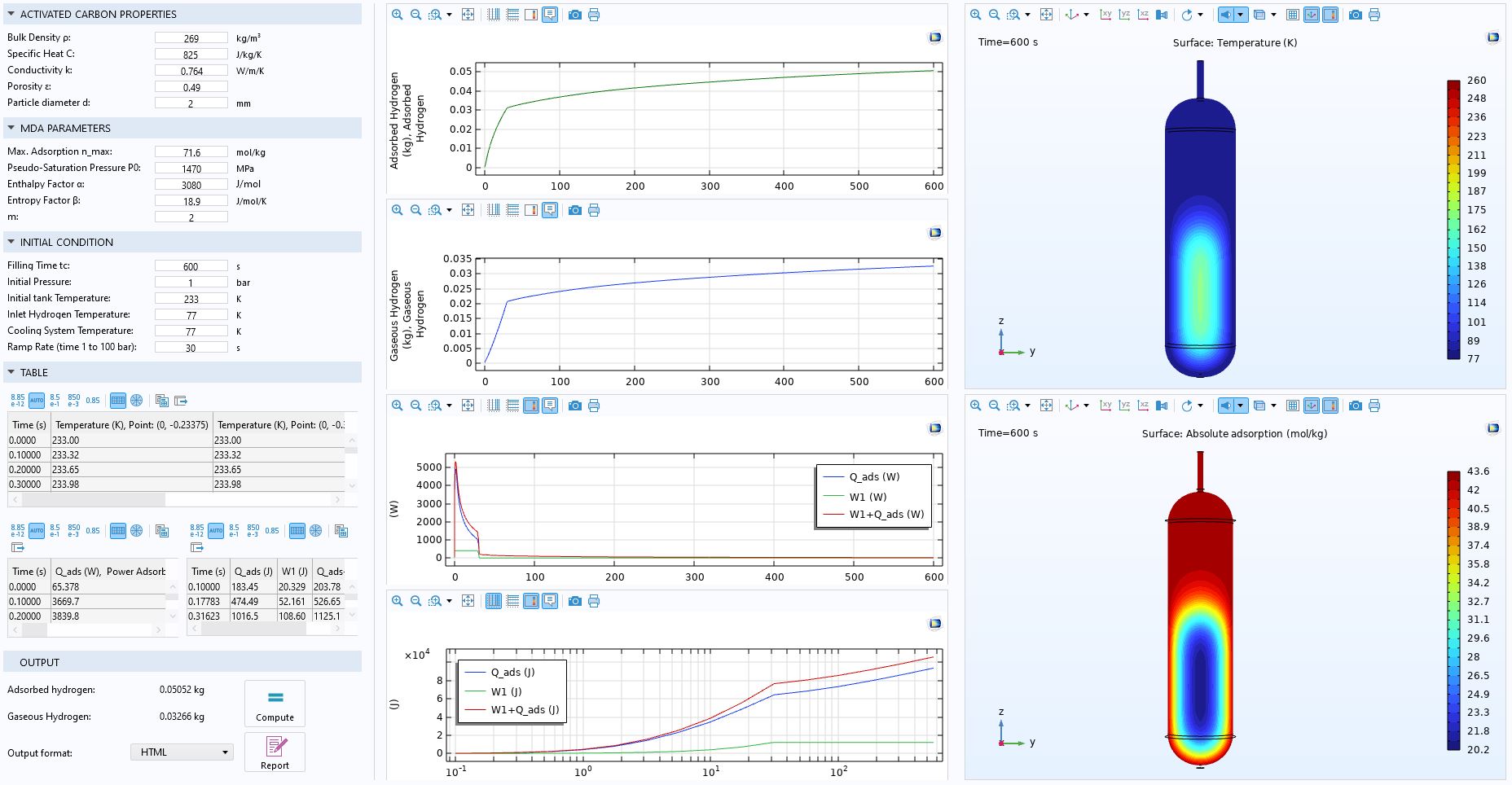
The Digital Twin developed by Spike Renewables is an advanced simulation tool that replicates tank behavior during operational phases, integrating thermal, fluid-dynamic, and adsorption phenomena. It enables analysis of the influence of geometric parameters, MOF and AC material properties, and process conditions, providing useful information for heat exchanger sizing, definition of operating pressures, and evaluation of storage capacity.
The model was implemented in COMSOL Multiphysics using the Application Builder, allowing simplified control of parameters without exposing users to the underlying numerical complexity. The Digital Twin enables rapid evaluation of alternative scenarios, comparison of different materials, and identification of the most suitable configurations for physical prototypes.
Application to Complex Geometries
The first version of the Digital Twin uses a simplified axisymmetric geometry to accelerate numerical validation, but its architecture is designed to be extended to complex three-dimensional geometries. This capability makes it possible to simulate tanks with real shapes, irregular internal components, and specific configurations of experimental prototypes. Extending the model to 3D also allows analysis of local temperature distributions, preferential flow paths, and differentiated adsorption zones, improving the predictive accuracy of the tool.
 From Simulation to Prototype Development
The Digital Twin activities are integrated with the mechanical design of the tank, auxiliary components, and heat exchanger, providing guidance on flows, thermal powers, and stored energy during filling and operation. Data obtained from simulation are used directly in the definition of the test bench and physical demonstrator designed within the MAST3RBoost project, ensuring consistency between simulated and real behavior.
The designed components—tank, heat exchanger, and auxiliary parts—have been manufactured and assembled, and will undergo an experimental testing campaign on a test bench at the EDAG Engineering GmbH laboratories in Germany, a partner of the MAST3RBoost project.
Innovative Electrolyzers and Hydrogen Storage
In addition to adsorption-based storage, Spike Renewables is involved in the development of innovative electrolyzer technologies designed to operate flexibly within integrated and hybrid systems. The focus is on producing hydrogen under conditions that favor interaction with storage systems based on MOFs and ACs, reducing energy consumption, operating pressures, and thermal impacts.
Extension of the Digital Twin to CO₂ Capture
The adsorption modelling implemented in the Digital Twin, based on thermo-kinetic equations and MDA models for MOFs and ACs, can be recalibrated to simulate CO₂ adsorption on microporous or functionalized materials. This enables the tool to be extended to CO₂ capture technologies, analyzing isotherms, thermal performance, adsorption kinetics, and optimal operating conditions for CCUS processes. This versatility makes the Digital Twin valuable not only for hydrogen storage, but also for the study of innovative CO₂ capture solutions in industrial contexts.
Industrial Hydrogen Expertise: Structural Works on Gas Holders
Beyond research and development activities, Spike Renewables also operates in the field of industrial hydrogen with advanced engineering capabilities. Among recent projects is the structural refurbishment of components of the S690 hydrogen gas holder at Altair Chemical S.r.l. The intervention included 3D surveys, deformation analysis, replacement of structural bracings, verification of the mechanical functionality of the movable bell, and definition of a long-term structural monitoring plan.
This work demonstrates our ability to integrate advanced research with applied engineering, addressing both new storage systems and existing industrial infrastructures.
Published articles
Computational Fluid Dynamic (CFD) analysis of a cold-adsorbed hydrogen tank during refilling
10th International Conference of Hydrogen Safety [ICHS 2023], 19-21 September 2023, Québec City, Canada
Preliminary analysis of refilling cold-adsorbed hydrogen tanks
78th Conference of Italian Thermal Machines Engineering Association [ATI 2023], 14-15 September 2023, Carpi, Italy
Optimization of a cold-adsorbed hydrogen tank during refilling using a Computational Fluid Dynamic (CFD) code
19th Conference on Sustainable Development of Energy, Water and Enviroment Systems [SDEWES 2024], 8-12 September 2024, Rome, Italy
Digital Twins of a cold-adsorbed Hydrogen tank by Activated Carbons and Metal Organic Frameworks
COMSOL Conference 2024, 22-24 October 2024, Florence, Italy
Study on the influence mechanism of fin structure on the filling performance of cold adsorption hydrogen storage tank
International Journal of Hydrogen Energy 94 (2024)
Integrated targeted pre-cooling tubes and fins for enhanced hydrogen adsorption in activated carbon storage tank
International Journal of Hydrogen Energy 146 (2025)

O2 evolution in an alkaline electrolyser


Simulation MOF177
Temperature in 288K, Time 50s
Adsorbed Hydrogen [mol/kg]

Tank Manufacturing by WAAM
Wire Arc Additive Manufacturing
in AIT Austrian Institute Of Technology